Key takeaways
- Nausea is 44% on Wegovy 2.4 mg but 20.3% on Ozempic 1 mg, the same molecule in two different trial populations.
- Nausea, diarrhea, vomiting and constipation are the four most common reactions on the Wegovy label.
- At the newer 7.2 mg dose (Wegovy HD), dysesthesia reaches 22%, against 6% at 2.4 mg. That is skin sensitivity, burning or tingling, and it is the one reaction that climbs sharply with dose.
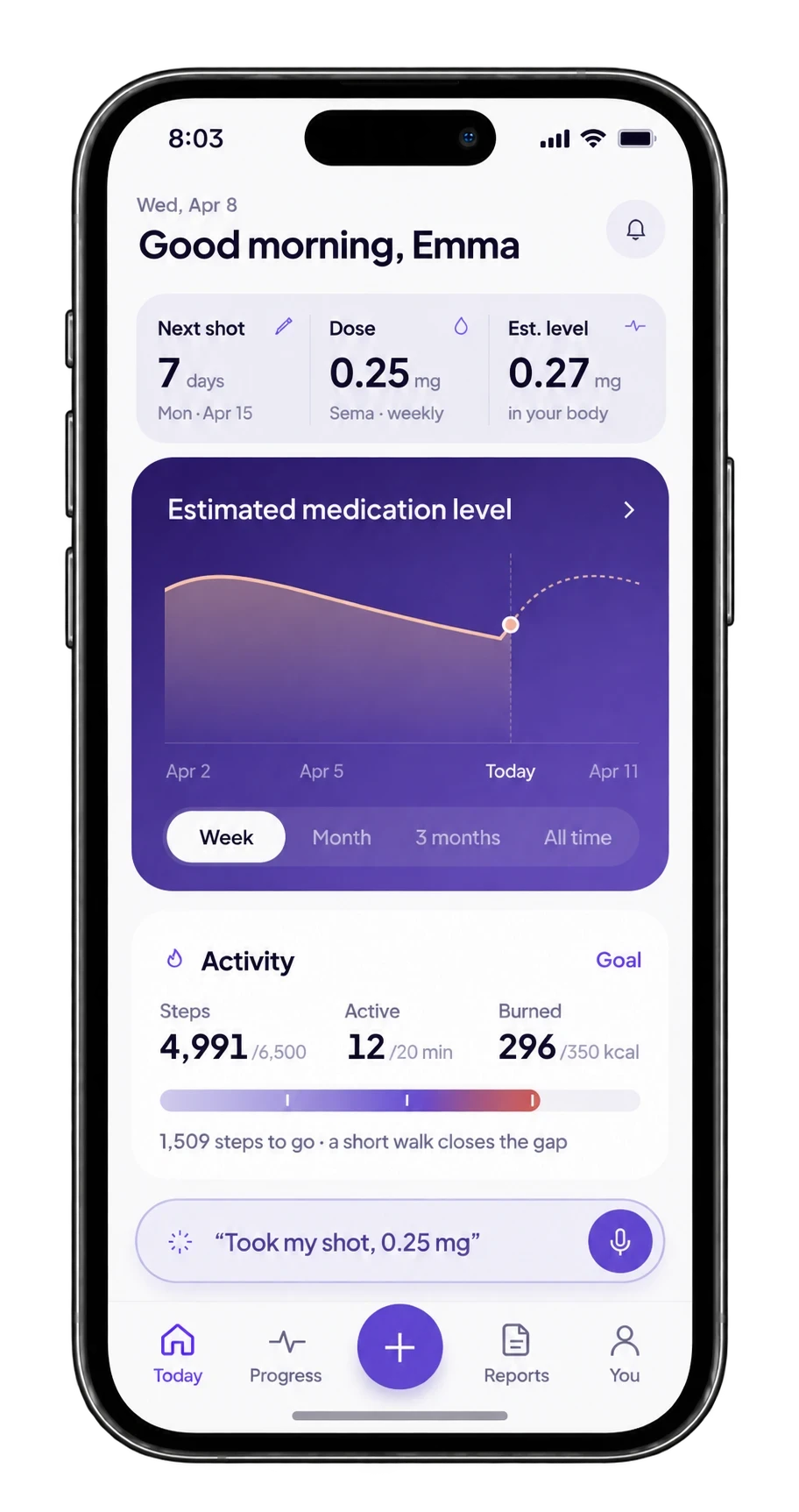
- Semaglutide has an elimination half-life of about one week and stays in your system for 5 to 7 weeks after the last dose.
- The boxed warning concerns thyroid C-cell tumors in rodents; the label says human relevance "has not been determined".
Why Wegovy and Ozempic report different numbers
Same drug, different trials, different people. Neither set of numbers is the real one.
Wegovy is semaglutide approved for weight reduction and cardiovascular risk reduction. Ozempic is semaglutide approved for type 2 diabetes. The tablets, sold as Rybelsus and now also as Ozempic tablets, are oral semaglutide for type 2 diabetes. The molecule is identical.
What differs is who was studied and at what dose. Wegovy goes to 2.4 mg and now 7.2 mg weekly. Ozempic trials in the table below ran at 0.5 mg and 1 mg. Higher doses, and a population taking it for weight rather than glucose, produce substantially higher reported rates.
Wegovy side effects, by rate
Every reaction reported in at least 2% of people and more often than placebo.
| Adverse reaction | Placebo | Wegovy 2.4 mg |
|---|---|---|
| Nausea | 16% | 44% |
| Diarrhea | 16% | 30% |
| Vomiting | 6% | 24% |
| Constipation | 11% | 24% |
| Abdominal pain | 10% | 20% |
| Headache | 10% | 14% |
| Fatigue | 5% | 11% |
| Dyspepsia | 3% | 9% |
| Dizziness | 4% | 8% |
| Abdominal distension | 5% | 7% |
| Eructation (burping) | <1% | 7% |
| Flatulence | 4% | 6% |
| Gastroenteritis | 4% | 6% |
| GERD | 3% | 5% |
| Gastritis | 1% | 4% |
| Hair loss | 1% | 3% |
| Dysesthesia | 1% | 2% |
The placebo column is the one to watch. 16 people in 100 felt sick on a dummy injection, so a good part of what you read online is not the drug. The gap between the columns is what semaglutide is actually adding.
What changes at the 7.2 mg dose, Wegovy HD?
Nausea barely moves. Skin sensitivity nearly quadruples.
Semaglutide now goes higher than the 2.4 mg most people know. The label lists a 7.2 mg strength, sold as Wegovy HD, and carries a separate adverse reaction table for it. It is pen only. The single-dose syringes stop at 2.4 mg, so if you are on syringes this dose is not available to you.
Nausea goes from 35% to 39%, which is close to flat. The reaction that genuinely changes is dysesthesia, which covers burning, tingling, altered or painful skin sensation. It runs 6% at 2.4 mg and 22% at 7.2 mg.
| Adverse reaction | Placebo | 2.4 mg | 7.2 mg |
|---|---|---|---|
| Nausea | 13% | 35% | 39% |
| Vomiting | 6% | 16% | 22% |
| Dysesthesia | 0% | 6% | 22% |
| Constipation | 8% | 19% | 20% |
| Abdominal pain | 7% | 9% | 12% |
| Fatigue | 5% | 9% | 11% |
| Headache | 7% | 8% | 9% |
| Dizziness | 1% | 5% | 6% |
| Hair loss | 1% | 3% | 6% |
| Flatulence | 2% | 2% | 4% |
Ozempic side effects, by dose
Lower throughout, because these are diabetes trials at lower doses.
| Adverse reaction | Placebo | 0.5 mg | 1 mg |
|---|---|---|---|
| Nausea | 6.1% | 15.8% | 20.3% |
| Vomiting | 2.3% | 5% | 9.2% |
| Diarrhea | 1.9% | 8.5% | 8.8% |
| Abdominal pain | 4.6% | 7.3% | 5.7% |
| Constipation | 1.5% | 5% | 3.1% |
The label also reports that gastrointestinal reactions overall occurred in 15.3% on placebo, 32.7% on 0.5 mg and 36.4% on 1 mg, and that the majority of nausea, vomiting and diarrhea happened during dose escalation rather than at random.
Do the tablets cause fewer side effects than the injection?
At the doses studied, the oral tablets look close to Ozempic, not to Wegovy.
| Adverse reaction | Placebo | 7 mg | 14 mg |
|---|---|---|---|
| Nausea | 6% | 11% | 20% |
| Abdominal pain | 4% | 10% | 11% |
| Diarrhea | 4% | 9% | 10% |
| Decreased appetite | 1% | 6% | 9% |
| Vomiting | 3% | 6% | 8% |
| Constipation | 2% | 6% | 5% |
Nausea is 20% at the 14 mg tablet, which is almost exactly the Ozempic 1 mg figure. There is also a 25 mg Wegovy tablet for weight reduction, studied in 204 patients, where 6.9% discontinued because of adverse reactions against 5.9% on placebo.
Where you are in your journey
Most of the rough stretches happen when the dose changes, not at random.
Wegovy starts at 0.25 mg once weekly, which is a starting dose rather than a treating dose. The label escalates every four weeks through 0.5 mg, 1 mg and 1.7 mg to a maintenance dose of either 1.7 mg or 2.4 mg. If you do not tolerate a step, the label explicitly says your prescriber can hold you at that dose for another four weeks rather than push on.
That instruction matters. Struggling at a step is an anticipated part of the schedule, not a sign that the drug is wrong for you.
Convert your prescribed dose into mL and syringe units →
How long does semaglutide stay in your system?
About a week per half-life, and five to seven weeks in total after your last dose.
This is the biggest practical difference from tirzepatide, which clears in roughly 5 to 6 days per half-life. Semaglutide's elimination half-life is approximately one week, and the label states it will be present in the circulation for about 5 to 7 weeks after the last 2.4 mg or 7.2 mg injection, or the last 25 mg oral dose.
Two consequences. Side effects do not stop the day you stop. And if you are planning a pregnancy, the long tail is the reason the label asks you to discontinue well in advance rather than the week before.
See your estimated medication level between doses →
What are the serious side effects of semaglutide?
Most reactions are uncomfortable rather than dangerous. These eleven are the ones the FDA wants you told about.
- Risk of thyroid C-cell tumors (5.1)
- Acute pancreatitis (5.2)
- Acute gallbladder disease (5.3)
- Hypoglycemia (5.4)
- Acute kidney injury due to volume depletion (5.5)
- Severe gastrointestinal adverse reactions (5.6)
- Hypersensitivity reactions (5.7)
- Diabetic retinopathy complications in patients with type 2 diabetes (5.8)
- Heart rate increase (5.9)
- Pulmonary aspiration during general anesthesia or deep sedation (5.10)
- Never share a FlexTouch pen between patients (5.11)
Two catch people out. Number 10 matters before any procedure, because these drugs slow stomach emptying and your anesthetist may assume an empty stomach when it is not. Tell your surgical, dental and endoscopy teams that you take semaglutide and when your last dose was. Number 9, heart rate increase, is a labeled warning for semaglutide that does not appear on the tirzepatide label.
What does the boxed warning actually say?
It is about thyroid tumours found in rodents, and the label is careful to say nobody knows yet whether it applies to people.
In rodents, semaglutide causes dose-dependent and treatment-duration-dependent thyroid C-cell tumors at clinically relevant exposures. It is unknown whether WEGOVY causes thyroid C-cell tumors, including medullary thyroid carcinoma (MTC), in humans as human relevance of semaglutide-induced rodent thyroid C-cell tumors has not been determined.
Semaglutide is contraindicated with a personal or family history of medullary thyroid carcinoma, or with MEN 2. Contraindicated means the label says do not use it, not "discuss the risks". The label also notes that routine calcitonin monitoring or thyroid ultrasound is of uncertain value for early detection.
Does semaglutide cause hair loss?
It is on the Wegovy label at 3%, against 1% on placebo, and it reaches 6% at 7.2 mg.
That is a real but modest signal. Rapid weight loss from any cause can trigger telogen effluvium, a temporary shedding phase, so the label figure and the mechanism people describe online are not necessarily the same thing.
Does semaglutide cause muscle loss?
The labels do not report muscle loss as an adverse reaction, and no incidence figure exists for it.
What is established is that weight lost quickly from any cause includes lean mass as well as fat. That is a general finding about weight loss rather than a semaglutide-specific label claim, which is why protein intake and resistance training come up so often.
Get a daily protein range based on your weight →
Does semaglutide stop birth control pills working?
Unlike tirzepatide, the semaglutide label does not require backup contraception.
This is a genuine difference between the two drugs and it is often confused. The tirzepatide label instructs people using oral contraceptives to switch to a non-oral method or add a barrier method for four weeks after starting and after each dose increase. The semaglutide label carries no equivalent instruction. It does advise care with oral medications generally, because gastric emptying is delayed.
Do these rates apply to compounded semaglutide?
No, and this matters more for semaglutide than for most drugs.
Every figure on this page comes from the FDA-approved prescribing information for Wegovy, Ozempic and the semaglutide tablets. Compounded semaglutide is not those products. It has not been through FDA approval for that formulation, so none of these incidence rates have been verified for it, and the strength and the salt form can differ from the approved product.
Compare what providers actually charge, and which sell compounded versus brand →
When should you call someone?
Discomfort is expected. These are the things that are not.
Persistent vomiting, an inability to keep fluids down, or severe abdominal pain that does not settle are reasons to contact your prescriber rather than wait it out. Severe gastrointestinal reactions are a labeled warning (5.6), and the label ties acute kidney injury directly to dehydration from those reactions (5.5). Severe abdominal pain radiating to the back, with or without vomiting, is the classic description of pancreatitis (5.2).
Set a daily fluid target with the hydration calculator →
Frequently asked questions
Why do Wegovy and Ozempic report different side effect rates?
They are the same molecule studied in different populations at different doses. Wegovy was studied for weight reduction at 2.4 mg and 7.2 mg; Ozempic was studied for type 2 diabetes at 0.5 mg and 1 mg. Nausea is 44% on Wegovy 2.4 mg and 20.3% on Ozempic 1 mg.
How common is nausea on semaglutide?
On the Wegovy label, nausea is reported in 44% of people at 2.4 mg against 16% on placebo. On the Ozempic label it is 15.8% at 0.5 mg and 20.3% at 1 mg against 6.1% on placebo.
What changes at the Wegovy 7.2 mg dose?
Nausea rises only slightly, from 35% to 39%. The reaction that changes most is dysesthesia, meaning burning, tingling or altered skin sensation, which runs 6% at 2.4 mg and 22% at 7.2 mg.
How long does semaglutide stay in your system?
Semaglutide has an elimination half-life of approximately one week. The label states it will be present in the circulation for about 5 to 7 weeks after the last 2.4 mg or 7.2 mg injection or the last 25 mg oral dose.
Do semaglutide tablets cause fewer side effects than the injection?
At the doses studied the oral tablets look similar to Ozempic rather than Wegovy. Nausea is 20% at the 14 mg tablet, close to the 20.3% reported for Ozempic 1 mg.
Does semaglutide stop birth control pills working?
The semaglutide label carries no backup contraception requirement. That instruction belongs to tirzepatide, whose label asks people on oral contraceptives to switch to a non-oral method or add a barrier method for four weeks after starting and after each dose increase.
Does semaglutide cause hair loss?
Hair loss appears on the Wegovy label in 3% of people at 2.4 mg against 1% on placebo, and in 6% at 7.2 mg.
Do these rates apply to compounded semaglutide?
No. Every figure comes from the FDA-approved prescribing information for Wegovy, Ozempic and the semaglutide tablets. Compounded semaglutide has not been through FDA approval for that formulation, so these incidence rates have not been verified for it.
